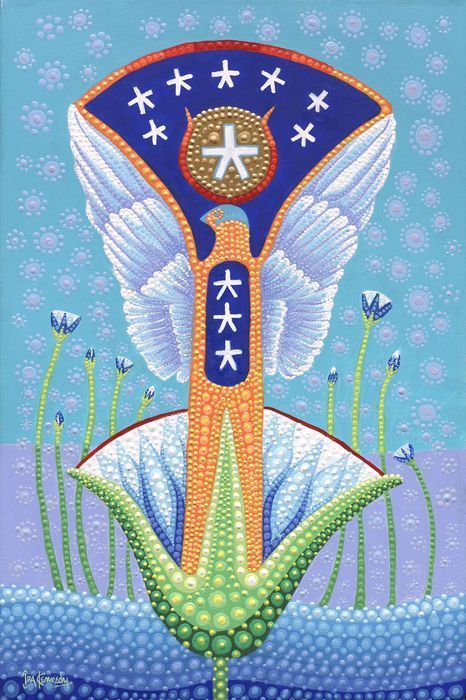
This painting is inspired by Egyptian symbolism. The lotus is a symbol of the sun, of creation and rebirth because at night the flower closes and sinks underwater, at dawn it rises and opens again.
Starting from the bottom we see lotus flowers emerging from the water. The largest lotus holds the winged Goddess Isis. Closely associated with the blue lotus, she is a benevolent deity in ancient Egyptian religion, known as the great mother, ideal wife, and goddess of magic, healing, wisdom, and motherhood, protecting women, children, the poor, and the dead.
At the very top of the painting is a solar disk surrounded with cow horns. This headdress signifies the union of solar and celestial power, symbolizing motherhood, fertility, and the nurturing of both the gods and the deceased.
The five pointed star in Egyptian mythology—known as the Seba—carries a much deeper, cosmic weight. It wasn't just a shape; it was a bridge between the living world and the eternal afterlife.
At the very top in the painting is one of Isis' symbols in the headdress that she wears: a solar disk surrounded by cow horns.